
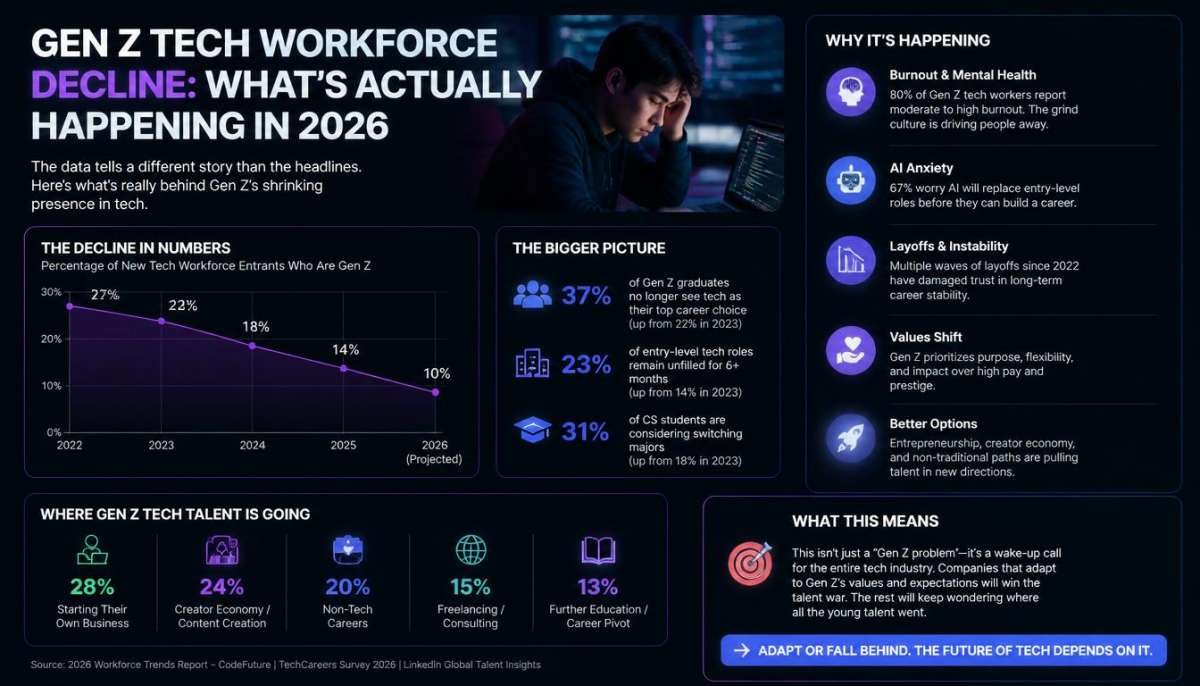
The Gen Z tech industry workforce decline isn’t happening because Gen Z lacks talent it’s happening because the traditional entry-level path into tech is disappearing. Junior tech job postings have fallen by roughly 35% since 2023, while AI automation and outsourcing have replaced many of the tasks that once trained new hires.
Although recent computer science graduates face rising unemployment, this doesn’t mean the tech industry is dying. It means breaking into tech now requires specialized skills, a strong portfolio, and AI fluency rather than relying on a degree alone.
Is the Gen Z tech workforce actually declining?

Yes at the entry level specifically, and the numbers are stark. Junior tech job postings have dropped about 35% since January 2023, according to labor research firm Revelio Labs. Meanwhile, computer science new grads are posting a 6.1% unemployment rate, nearly double the rate of philosophy majors and higher than almost every non-STEM field. Computer engineering grads are doing even worse, at roughly 7.5%.
None of this means tech is dying. It means the bottom rung of the career ladder — the roles that used to train people into the industry has been compressed, automated, or quietly removed.
The core problem: entry-level roles are vanishing, not tech itself

For decades, entry-level meant something specific: drafting reports, pulling data, fixing bugs nobody senior wanted to touch, writing boilerplate code. That’s exactly the category of work large language models and AI coding assistants now do in seconds.
In practice, this means a junior developer who used to spend six months learning the ropes on low-stakes tasks now has fewer of those tasks to learn on because a tool already did them before the ticket got assigned.
Technology roles are the most exposed of any industry. Roughly 40% of tech employers say AI is already replacing entry-level positions, the highest share of any sector, according to a 2026 GMAC recruiter survey reported by Fortune. Manufacturing is close behind, but tech is leading the shift.
Also Read : The Future of Housing Market for Gen Z in 202
Why entry-level now means 2+ years experience
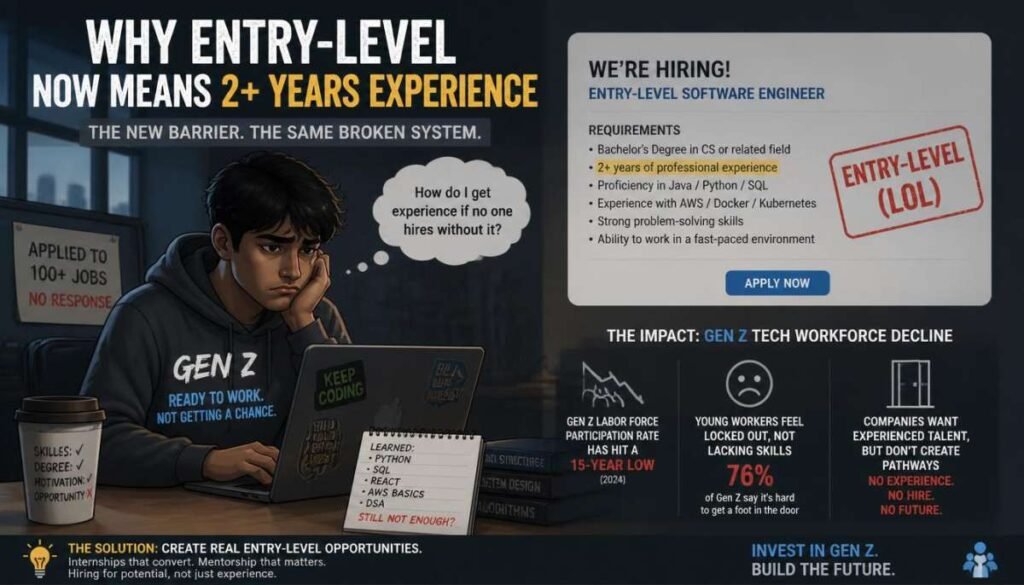
Here’s the part that makes Gen Z job seekers want to throw their laptop into the sea: more than 60% of entry-level software and IT job postings now require three or more years of experience. That’s not entry-level. That’s a catch-22 with a job title slapped on it.
Compounding this, a meaningful share of open listings aren’t real hires at all. Roughly 45% of HR professionals admit to regularly posting “ghost jobs” with no intention of filling them, often to test the market, build a talent pipeline, or make the company look like it’s growing. For a job seeker, that means a chunk of every application goes into a void that was never going to respond.
Why this is happening: four forces stacking at once
No single cause explains the Gen Z tech workforce decline. It’s four trends compounding simultaneously.
1. AI absorbing junior tasks. Coding assistants, automated QA, and AI-driven documentation tools now do the “learning work” that used to justify hiring a junior in the first place.
2. A post-2022 hiring hangover. Tech massively over-hired in 2021–2022, then spent 2023–2025 correcting. That correction put experienced engineers back on the market, and companies naturally prioritize them over unproven grads.
3. Credential inflation. A decade of rising CS enrollment and coding bootcamps created far more junior candidates than there are junior roles to absorb them.
4. A structural reset, not a cyclical dip. Analysts increasingly describe this as permanent, not temporary. Once a company rebuilds its workflows around a leaner, AI-augmented team, there’s little incentive to recreate the old volume of junior hiring even once the economy improves.
That last point matters more than people realize. Industries cutting junior headcount now are setting themselves up for a thinner pipeline of mid-level talent five to ten years from now. Gen Z is absorbing the cost of a decision the industry is making for its own future.
It’s not just vibes Gen Z feels it more than other groups
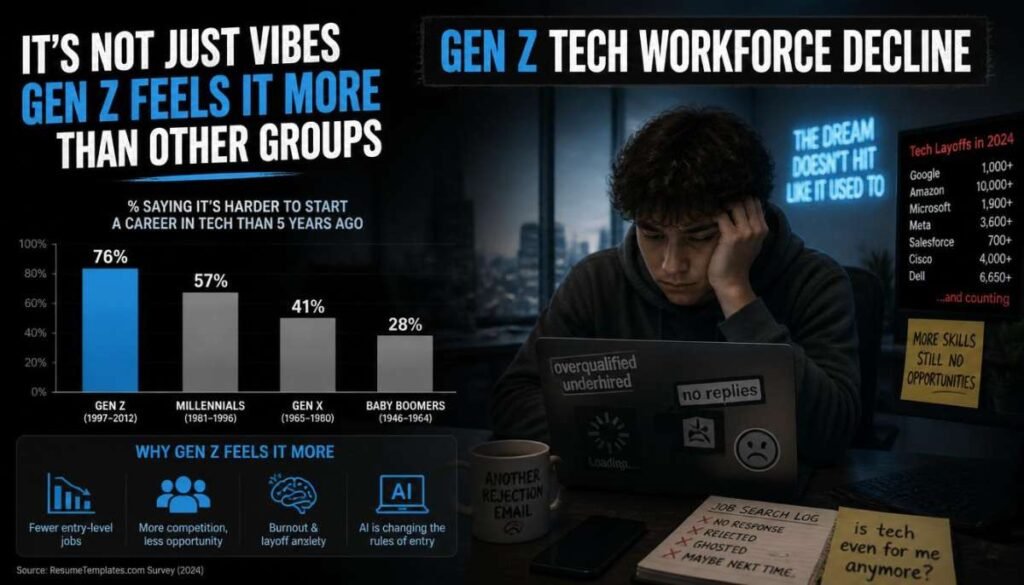
Job satisfaction data backs this up. Just 57% of workers under 25 report being satisfied with their jobs, compared to 72% of workers over 55 and in a year when overall job satisfaction hit a record high, young workers were the only group whose satisfaction dropped.
Nearly half of Gen Z job hunters (49%) now say they believe AI has reduced the value of their degree. That’s not just economic anxiety it’s a direct response to watching automated systems do work they spent four years training for.
Where Gen Z is still winning in tech
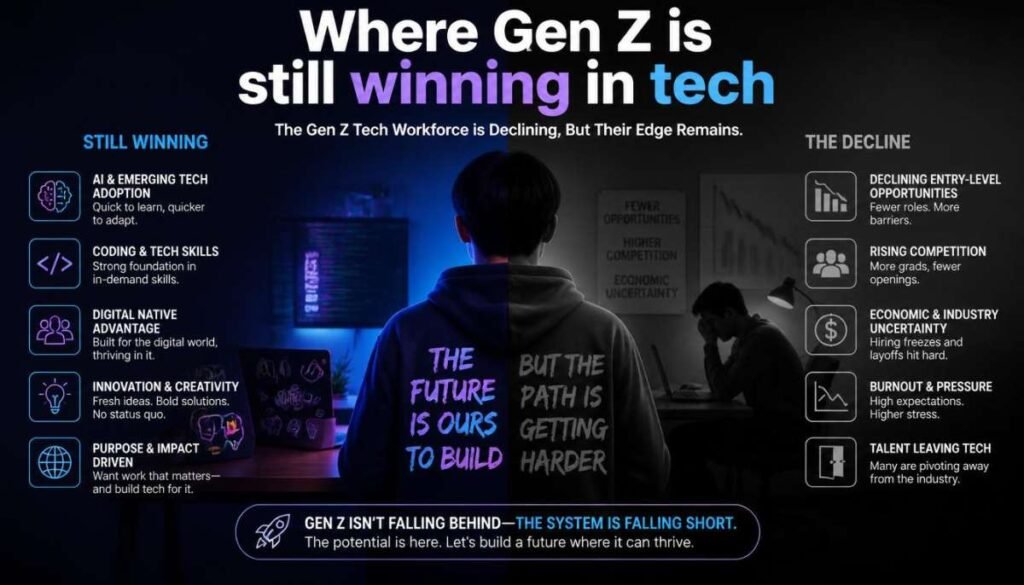
The picture isn’t uniformly bleak. Specialization is the clearest differentiator between Gen Z workers who are landing offers and those stuck refreshing job boards.
Roles in AI/ML engineering, cybersecurity, cloud infrastructure, and data engineering remain near full employment, even as generalist software engineering roles struggle. The Bureau of Labor Statistics still projects 15% growth in software developer employment through 2034 about five times the average for all occupations but that growth is concentrated in specialized, harder-to-automate work, not generic coding.
Starting salaries also tell a more optimistic story than the unemployment headlines suggest. Computer science majors are still projected to earn around $81,500 to start in 2026, one of the highest starting salaries of any major, even with the higher unemployment rate. The market isn’t rejecting CS grads outright it’s rejecting the generalist version of the role that used to be enough.
How Gen Z is adapting
Rather than waiting for entry-level hiring to recover, a lot of Gen Z workers are building around the problem entirely.
- 57% of Gen Zers now juggle a side hustle alongside or instead of traditional employment, compared to just 21% of Baby Boomers.
- Nearly 38% of recent grads are considering starting their own business rather than pursuing a corporate role.
- 32.5% are exploring gig work, and 28% are building freelance income.
- Despite the shrinking pipeline, Gen Z still makes up over 80% of all tech job applications, according to ICIMS data they haven’t given up on the industry, they’re just applying differently.
In practice, this looks like grads treating a job search less like a single funnel and more like a portfolio: freelance contracts, open-source contributions, a niche specialization, and a side project that doubles as proof of skill all running at once instead of one resume sitting in an ATS queue.
What actually moves the needle right now
Recruiters and labor economists tracking this trend consistently point to the same handful of strategies:
- Specialize instead of staying a generalist. Cybersecurity, cloud infrastructure, and applied ML consistently outperform generic “software engineer” postings.
- Build a visible body of work. GitHub contributions, shipped side projects, and public writing carry more weight than a GPA line on a resume.
- Treat AI fluency as table stakes. Employers aren’t looking for people who avoid AI tools — they’re looking for people who direct them effectively. Roughly 35% of entry-level postings now explicitly require AI skills.
- Network past the black-box application. A large share of relevant hires still happen through warm introductions rather than cold job-board submissions.
- Expect a longer timeline. Time-to-offer for CS grads has roughly doubled compared to 2021 benchmarks this is a marathon, not a four-month sprint.
None of this erases the structural problem. But it’s the difference between candidates who get traction and candidates who don’t.
The bottom line
The Gen Z tech workforce decline is real, measurable, and driven by structural shift not generational laziness or lack of hustle. AI has absorbed a meaningful share of the tasks that used to train junior hires, hiring hasn’t caught up to the graduate pipeline, and “entry-level” has quietly redefined itself into something closer to mid-level.
The generation entering tech right now is doing so under conditions no previous cohort faced: automation eating the on-ramp before they ever got a chance to use it. The ones finding traction aren’t the ones with the best degree they’re the ones treating this as a specialization and positioning problem, not a luck proble
Gen Z Tech Hiring Key 2026 Data Points
| Metric | Figure | Source |
| Decline in junior tech job postings since Jan 2023 | ~35% | Revelio Labs |
| CS new-grad unemployment rate | 6.1% | Federal Reserve Bank of New York |
| Computer engineering new-grad unemployment rate | 7.5% | Federal Reserve Bank of New York |
| Entry-level software/IT jobs requiring 3+ years experience | 60%+ | Rezi.ai 2026 report |
| Tech employers using AI to replace entry-level roles | ~40% | GMAC recruiter survey (via Fortune) |
| Entry-level postings requiring AI skills | ~35% | NACE |
| Gen Z share of all tech job applications | 80%+ | ICIMS |
| Projected CS starting salary, Class of 2026 | ~$81,500 | NACE Winter Salary Survey |
FAQ SECTION
Is the tech industry actually shrinking for Gen Z, or is this overblown?
It’s real but specific: overall tech employment isn’t collapsing, but entry-level tech hiring has dropped sharply, with junior job postings down around 35% since 2023.
Why is computer science unemployment higher than less technical majors?
Computer science new grads face a 6.1% unemployment rate higher than philosophy or art history because AI has automated much of the routine work junior developers used to be hired to do, on top of a post-2022 hiring correction.
Is AI actually replacing entry-level tech jobs?
Yes, at least partially around 40% of tech employers report using AI to replace entry-level positions, the highest share of any industry surveyed.
What tech specializations are still hiring Gen Z grads?
Cybersecurity, cloud infrastructure, AI/ML engineering, and applied data roles remain near full employment, even as generalist software engineering roles have contracted.
Are entry-level job postings honest about what they require?
Often not. More than 60% of entry-level software and IT postings require 3+ years of experience, and a significant share of listed jobs are “ghost jobs” with no real hiring intent behind them.
How are Gen Z workers responding to the tech hiring slowdown?
Many are diversifying: 57% now hold a side hustle, and a large share are pursuing freelance work, gig work, or entrepreneurship instead of relying solely on traditional job applications.

Sebastian Vane is a digital native and trend strategist obsessed with the intersection of tech and culture. From decoding the latest viral memes to exploring the future of the creator economy, Sebastian provides high-signal insights for a generation that never sleeps. No fluff, just vibes and value